CASPER™ Carotid Stent: Dual-Layer Micromesh Technology for Plaque-Prolapse Prevention in CAS
Автор: Modern Medical Solutions Editorial Team
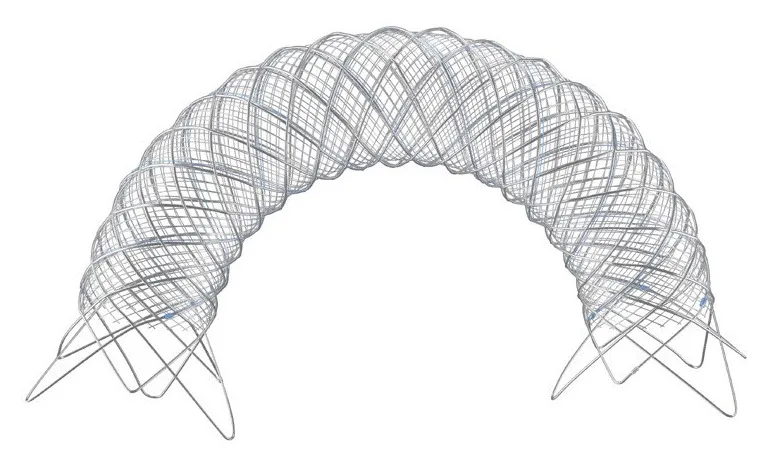
The CASPER™ from MicroVention Terumo features a dual-layer architecture — outer nitinol scaffold plus inner micromesh liner — that physically blocks plaque prolapse through stent struts during carotid artery stenting, reducing the primary embolic stroke mechanism of CAS with clinical validation from the CRISTAL randomised trial.
What Is the CASPER™ Carotid Stent?
The CASPER™ (Carotid Artery Stent with Plaque-trapping Elastomeric liner for Retraction) is a dual-layer self-expanding carotid stent from MicroVention Terumo. Standard single-layer carotid stents have inter-strut gaps of 1–3 mm or larger through which soft or ulcerated atherosclerotic plaque can herniate during and after stent deployment, generating emboli that travel to the intracranial circulation. CASPER solves this with an inner micromesh liner — a fine-mesh net over the stent’s inner lumen face — that physically blocks plaque prolapse through the outer struts.
The outer scaffold provides the radial force and vessel wall apposition needed to pin plaque against the wall; the inner micromesh provides a microstructural plaque barrier. This combination achieves macrostructural support and plaque containment in a single deployable device without adding clinically significant profile compared to conventional single-layer stents.
CRISTAL Trial Evidence
The CRISTAL randomised controlled trial evaluated CASPER versus standard single-layer carotid stents for CAS with the primary endpoint of 30-day stroke or death. CASPER demonstrated a statistically significant reduction in the primary endpoint, driven specifically by a reduction in minor stroke — consistent with the device’s mechanism of reducing microembolic plaque prolapse. This evidence places CASPER on a distinct clinical evidence tier from conventional carotid stents.
The CRISTAL data is particularly compelling for patients with soft or ulcerated plaque morphology on CT angiography or duplex ultrasound, as these plaques carry the highest risk of intra-procedural prolapse through standard stent struts. CASPER should be strongly considered the default carotid stent in these anatomical high-risk cases.
Technical Specifications
Diameters 5–10 mm, dual-layer lengths 16–40 mm. Catalog: CPR-0520-143RX through CPR-1030-143RX. Working length 143 cm, 0.014 in RX monorail delivery, 6F guide catheter compatible. The open-cell outer scaffold provides flexibility for tortuous carotid anatomy; the inner micromesh maintains plaque containment across the full stent length.
CASPER is compatible with standard carotid stenting access systems and EmPro embolic protection device, enabling the complete dual-protection protocol from a single MicroVention Terumo product portfolio.
Deployment Technique
Deploy EmPro filter distal to the bifurcation before advancing CASPER. Size CASPER to the reference common carotid artery diameter with 1–1.5 mm oversize. Extend stent coverage 10 mm proximal and distal to the stenosis to ensure complete micromesh liner coverage of the plaque segment. Predilate high-grade stenoses with a 4 mm coronary balloon if CASPER delivery is impeded.
Deploy CASPER by steady sheath retraction under road-map guidance. The dual-layer design increases stiffness slightly compared to single-layer stents — ensure smooth catheter tracking before deploying. Post-dilate with an undersized balloon (1 mm below reference vessel) to optimise apposition without over-expansion. Retrieve the EmPro filter after post-dilation. DAPT for minimum 30 days per institutional protocol.
Ordering Through Modern Medical Solutions
Modern Medical Solutions is the authorised MicroVention Terumo distributor for Tajikistan and Afghanistan. CASPER is available across the full 5–10 mm diameter and 16–40 mm length range for carotid stenting programmes in Tajikistan and Afghanistan.
Contact Modern Medical Solutions to discuss CASPER alongside EmPro as a complete carotid stenting system with dual embolic protection. The team can provide access to the CRISTAL trial data summary for institutional adoption discussions.