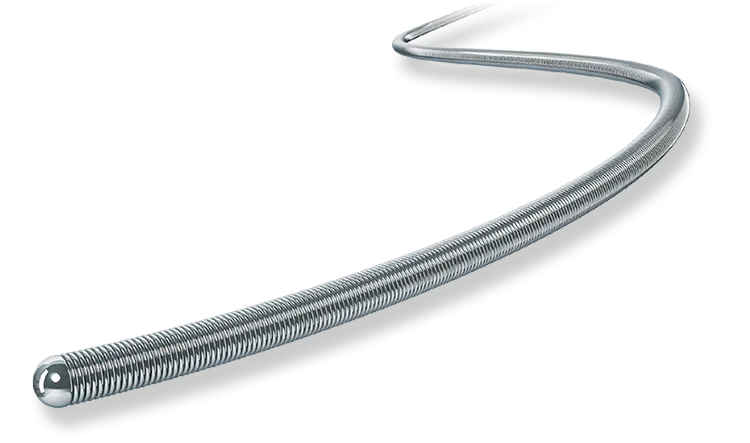
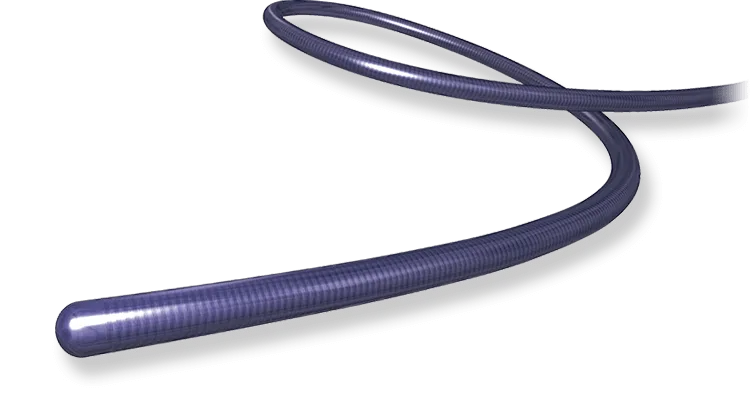
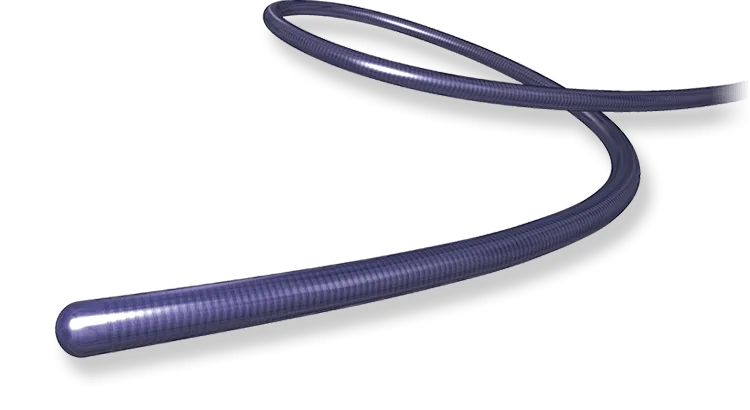
ASAHI Corsair® Pro XS: Lower-Profile Rotatable Microcatheter for Tight CTO Caps and Septal Channels
Муаллиф: Modern Medical Solutions Editorial Team
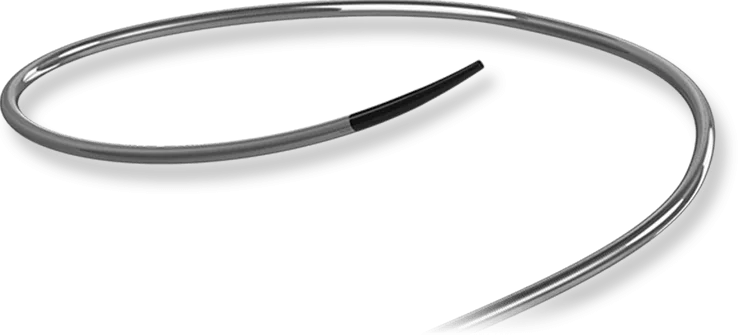
ASAHI Corsair® Pro XS delivers the same rotatable braided-shaft drilling function as Corsair Pro in a reduced 2.1F distal profile, enabling advancement through proximal caps and septal collateral channels that are too tight for the standard Corsair Pro.
What Is the ASAHI Corsair® Pro XS?
The ASAHI Corsair® Pro XS is the lower-profile variant of the Corsair Pro microcatheter family, sharing the same rotatable braided-shaft design and active drilling capability but in a reduced 2.1F distal shaft diameter compared to the standard Corsair Pro’s 2.6F. This size reduction — equivalent to approximately 0.17 mm less outer diameter at the distal shaft — is clinically significant in two specific scenarios: very tight CTO proximal caps where standard Corsair Pro cannot advance despite rotation, and septal collateral channel navigation in retrograde CTO cases.
Both XS variants retain the 1.3F tip diameter of standard Corsair Pro, meaning the distal-most tip crossing profile is identical. The shaft size difference applies to the proximal portion of the distal segment and allows the XS to traverse tighter passages within the occlusion body after the tip has engaged the cap. The hydrophilic coating extends 70 cm on the 135 cm variant and 85 cm on the 150 cm variant, covering more of the shaft than standard Corsair Pro’s 60 cm.
Catalog numbers: CSR135-21S (135 cm, 70 cm hydrophilic), CSR150-21S (150 cm, 85 cm hydrophilic). The extended hydrophilic zone of XS compared to standard Corsair Pro (70–85 cm vs. 60 cm) reflects its typical use in longer passages — septal channels can be 5–20 cm long, requiring hydrophilic coating well proximal to the tip.
Technical Specifications
Tip diameter: 1.3F (same as Corsair Pro). Distal shaft diameter: 2.1F (smaller than Corsair Pro’s 2.6F). Tip inner diameter: 0.015 inch. Shaft inner diameter: 0.019 inch (marginally larger inner lumen than Corsair Pro’s 0.018 inch — XS maintains wire clearance despite smaller outer diameter by optimising wall thickness). Hydrophilic coating: 70 cm (135 cm variant) or 85 cm (150 cm variant).
Working lengths: 135 cm (CSR135-21S) and 150 cm (CSR150-21S). The 150 cm XS is the standard choice for retrograde CTO cases where the microcatheter must traverse the septal channel (5–20 cm) and the retrograde vessel length (30–50 cm) before reaching the retrograde cap position.
How Corsair Pro XS Compares to Alternatives
Corsair Pro XS vs. Corsair Pro: Use Corsair Pro as the default; reserve XS for confirmed failure of standard Corsair Pro to advance despite correct rotation technique. Switching prematurely to XS when standard Corsair Pro could have been advanced with optimised technique is wasteful. The decision point is typically 20–30 clockwise turns of Corsair Pro with forward pressure at a resistant proximal cap with no advancement — this is when XS should be selected.
Corsair Pro XS vs. ASAHI Caravel (1.4F/1.9F): Caravel is smaller than XS and lacks the rotatable braided shaft. Caravel is appropriate for small vessels and septal channels where rotation drilling is not needed and size is the primary constraint. XS is preferred when rotatable drilling capability is needed in a smaller profile — i.e., when the channel is tight AND fibrous.
Corsair Pro XS vs. ASAHI SASUKE (1.5F/2.5F): SASUKE is a dedicated low-profile microcatheter for extreme proximal cap cases. The product hierarchy is typically: Corsair Pro → Corsair Pro XS → SASUKE for progressively tighter proximal caps. SASUKE is reserved for the most extreme cases.
Clinical Applications and Indications
Tight CTO proximal caps where standard Corsair Pro rotation fails: the most common XS indication. After the CTO wire (Fielder XT, Gaia, or Confianza Pro) has crossed the proximal cap, standard Corsair Pro is advanced with rotation over the wire but cannot penetrate the fibrous tissue surrounding the wire track. XS’s smaller 2.1F shaft frequently advances in this situation when Corsair Pro cannot.
Septal collateral channel navigation in retrograde CTO cases is the second major indication. Septal channels frequently have internal diameters of 0.3–0.6 mm, making the 2.1F (0.70 mm) XS shaft marginally more navigable than the 2.6F (0.87 mm) Corsair Pro in the tightest channels. The extended hydrophilic coating of XS (70–85 cm vs. 60 cm) is particularly valuable in this application.
Small epicardial collateral channels (also used as retrograde CTO conduits) frequently require XS rather than standard Corsair Pro due to their limited calibre and tortuous course through the epicardial fat plane.
Technique and Usage Tips
The rotation technique for XS is identical to standard Corsair Pro: clockwise rotation at the hub (10–20 turns) before advancing, counterrotate before retracting. The smaller shaft diameter means XS exerts less drilling force per rotation cycle than standard Corsair Pro — more rotation cycles may be needed to advance the same distance through fibrous tissue. Budget additional procedure time when using XS in dense fibrous occlusions.
In septal channels, advance XS with 5–10 clockwise turns maximum before attempting forward advancement. Septal channels are more fragile than occlusion bodies — excessive rotation force risks channel perforation. If XS does not advance freely with gentle rotation in a septal channel, consider whether the channel anatomy is suitable for retrograde approach or whether an alternative septal channel should be selected.
Wire management in retrograde cases: after XS has traversed the septal channel, the wire within XS (typically Fielder XT) can be exchanged for a more shapeable wire (SION or custom-shaped Gaia) for the distal retrograde cap engagement, using XS as the exchange platform in the retrograde vessel.
Ordering and Availability Through Modern Medical Solutions
Modern Medical Solutions supplies ASAHI Corsair® Pro XS in 135 cm (CSR135-21S) and 150 cm (CSR150-21S) configurations to CTO programmes in Tajikistan and Afghanistan. XS is recommended as a second-line microcatheter complement to standard Corsair Pro in CTO case sets, not as a primary-stocking item for centres performing only simple CTO cases.
Contact Modern Medical Solutions via the website for stock availability and ordering. Retrograde CTO technique training incorporating Corsair Pro XS septal channel navigation is available through the clinical support programme.