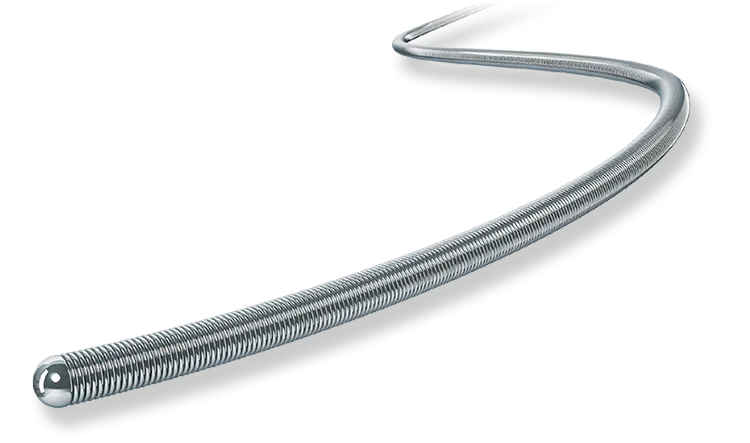
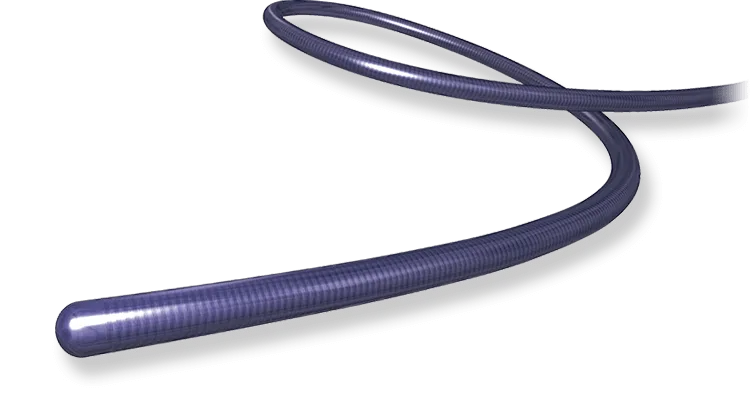
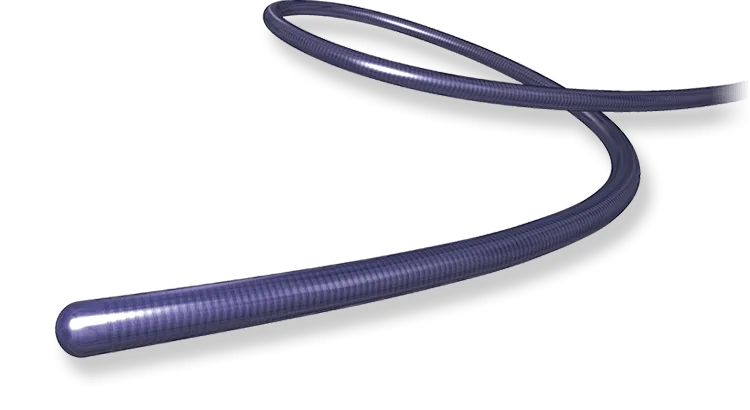
ASAHI CHIKAI® black: Enhanced Pushability for Tortuous Intracranial Navigation
Муаллиф: Modern Medical Solutions Editorial Team
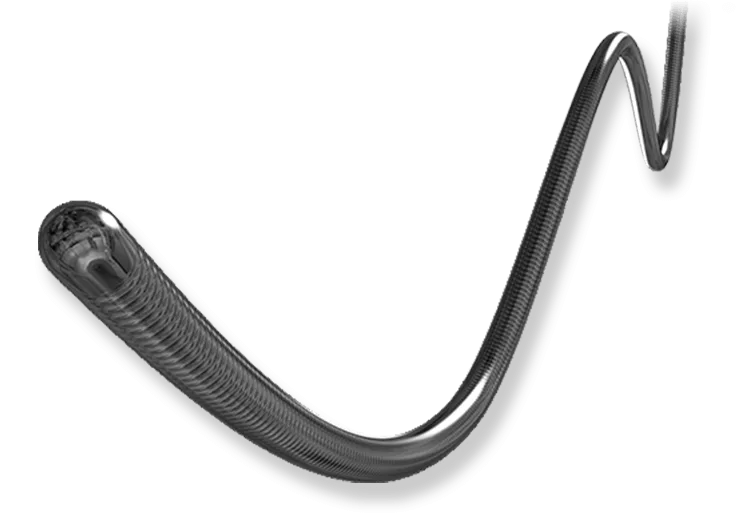
ASAHI CHIKAI® black adds a 150 cm polymer jacket to the standard CHIKAI neurovascular microguidewire platform, providing greater microcatheter push support through tortuous intracranial anatomy while retaining the 0.014-inch profile and Headway microcatheter compatibility.
What Is the ASAHI CHIKAI® black?
ASAHI CHIKAI® black is a variant of the standard CHIKAI neurovascular microguidewire that adds a 150 cm polymer jacket along the proximal-to-mid shaft to increase pushability when advancing microcatheters through tortuous intracranial anatomy. The polymer jacket converts what would otherwise be a flexible wire-mediated push into a more rigid column force transmission, reducing the tendency for the wire to buckle in tortuous segments proximal to the target vessel.
The clinical problem it addresses is specific: during standard CHIKAI use, there are cases where the wire has been successfully positioned in the target intracranial location (aneurysm fundus, distal MCA, PCA territory) but the microcatheter cannot be advanced over the wire to the tip position because friction at multiple tortuous vessel segments accumulates to exceed the push force that the flexible CHIKAI shaft can transmit. CHIKAI black’s polymer jacket provides the additional shaft rigidity needed to transmit push force over longer tortuous access routes.
CHIKAI black is available in round-curve and 90-degree angled tip configurations, unlike standard CHIKAI which offers straight and round-curve. The 90-degree tip option is designed for very angulated vessel take-offs — particularly posterior communicating artery (PCoA) aneurysms, PICA aneurysms, and distal vessel approaches requiring sharp-angle navigation — where standard round-curve geometry is insufficient.
Technical Specifications
Outer diameter: 0.014 inch throughout. Polymer jacket: 150 cm (significantly longer than SION Black’s coronary equivalent). Hydrophilic coating: distal segment (specific extent per configuration). Tip shapes: round curve and 90-degree angled. Compatible microcatheters: Headway 17, Headway 21, Headway 27 family (MicroVention-Terumo).
The 150 cm polymer jacket length is designed to cover the full intracranial access route in most adult patients — from the common carotid artery bifurcation through the carotid siphon and M1 MCA segment, or from the vertebral artery origin through the basilar artery to the P1 PCA segment. This ensures that the jacket’s pushability enhancement is active throughout the most resistance-generating portions of the intracranial access route.
How CHIKAI black Compares to Alternatives
CHIKAI black vs. standard CHIKAI: Use standard CHIKAI first for all neurointerventional procedures. Reserve CHIKAI black for confirmed pushability-limited cases where the wire is in position but the microcatheter cannot be advanced to the tip. Switching prematurely to CHIKAI black sacrifices some tip compliance without necessity.
CHIKAI black vs. stiffer 0.016-inch neuro microwires: Some procedures (particularly stent-assisted coiling with large stents or flow diverters) are performed with 0.016-inch guidewires for greater support. CHIKAI black is a 0.014-inch wire and may not be compatible with all 0.016-inch-optimised delivery systems. Confirm device compatibility before choosing CHIKAI black as the support wire for large device delivery.
CHIKAI black vs. guide catheter extension in the neuro setting: In endovascular neurovascular procedures, guide catheter extension (e.g., Navien aspiration catheter repositioning) provides proximal support that can reduce the pushability demands on the microwire. If CHIKAI black is considered because of proximal access friction, repositioning the guide catheter more distally may solve the problem without requiring a wire change.
Clinical Applications and Indications
Tortuous carotid siphon or vertebral artery anatomy where microcatheter advancement stalls despite correct CHIKAI wire position: CHIKAI black’s 150 cm polymer jacket provides the additional push transmission needed to advance the microcatheter past the tortuous segments and to the intracranial target.
Distal intracranial access for distal aneurysms (distal MCA M2/M3, distal ACA A2/A3, PICA, AICA): these cases require the microcatheter to track over the wire through multiple intracranial bends to reach a very distal target. CHIKAI black’s enhanced pushability is valuable in these cases, particularly when combined with the 90-degree tip for angulated distal vessel take-offs.
Flow diverter delivery in cases with complex cervical and intracranial anatomy: CHIKAI black (300 cm equivalent exchange length if available) provides the stable wire platform needed for delivery catheter exchange over the wire in tortuous cases where standard CHIKAI is insufficient for consistent catheter tracking.
Technique and Usage Tips
The 90-degree tip requires careful initial positioning: the sharp angle facilitates entry into angulated vessels but can also cause the wire to ‘hook’ inadvertently into branch vessels during advancement to the target. Use biplane fluoroscopy or rotational DSA to confirm tip direction before each rotation-and-advance step with the 90-degree variant.
The polymer jacket of CHIKAI black provides more rigidity but also slightly less tactile feedback than standard CHIKAI in the mid-shaft. Monitor wire position more frequently under fluoroscopy — especially at the intracranial tip — during microcatheter advancement, as the stiffer jacket can mask vessel wall contact sensations that would typically alert the operator to a problematic tip position.
Wire removal after procedure completion: withdraw CHIKAI black with the same caution as standard CHIKAI — no sudden pulls, advance the microcatheter to any adherence point before retraction. The polymer jacket increases the risk of wire entanglement with stent struts compared to standard CHIKAI if the wire is rotated at a stent-crossing point; always withdraw CHIKAI black without rotation when it has been used alongside an intracranial stent.
Ordering and Availability Through Modern Medical Solutions
Modern Medical Solutions supplies ASAHI CHIKAI® black in round-curve and 90-degree tip configurations to neurointerventional centres in Tajikistan and Afghanistan as the authorised MicroVention distributor for Terumo products. CHIKAI black is recommended as a second-line neuro microwire complement to standard CHIKAI for centres managing complex intracranial anatomy.
For neurointerventional product support, including guidance on CHIKAI vs. CHIKAI black selection for specific anatomical cases, contact Modern Medical Solutions via the website. Product specifications: medical.asahi-intecc.com.