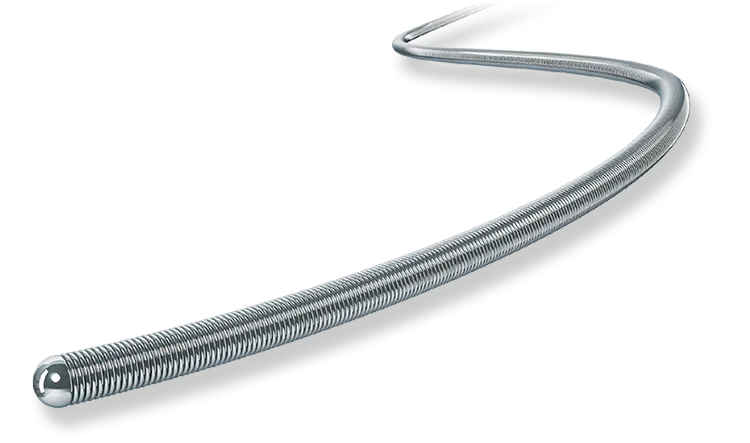
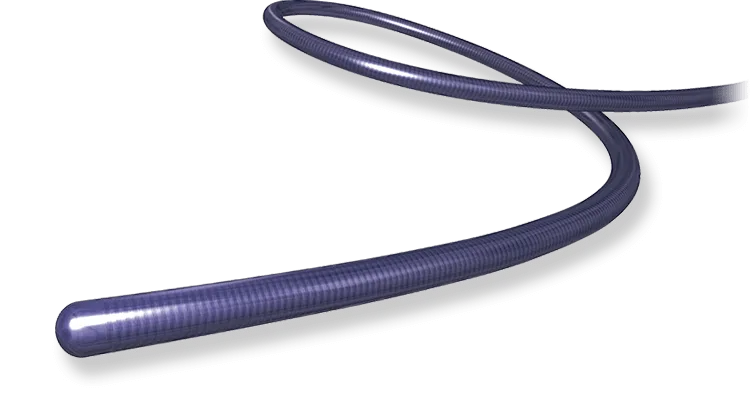
Grand Slam®: High-Support Rail Wire for Complex Device Delivery
Муаллиф: Modern Medical Solutions Editorial Team
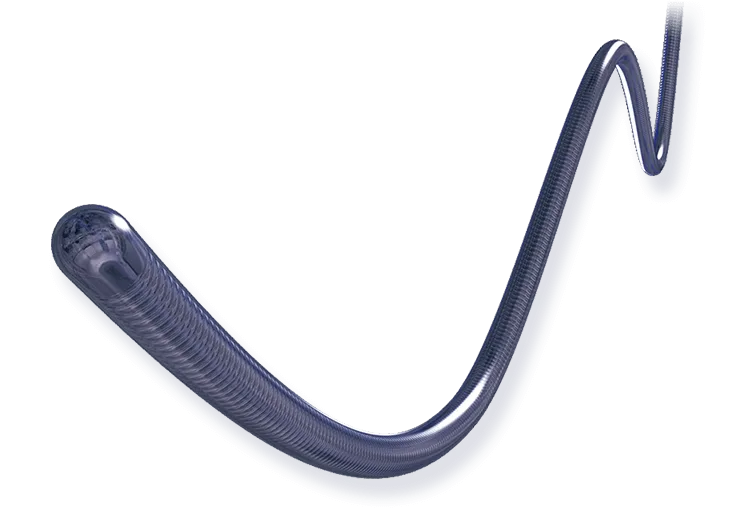
Grand Slam® is a stiff-shaft support coronary guidewire designed to serve as a delivery rail for balloons and stents in severely tortuous or calcified vessels, providing the guidewire backbone required when standard workhorse wires offer insufficient support for device advancement.
What Is the Grand Slam®?
The Grand Slam® is a high-support coronary guidewire — a category distinct from crossing wires or CTO penetration wires. Its function is not to cross lesions but to serve as a rigid, stable rail over which balloons, stents, rotational atherectomy burrs, and other devices can be delivered in anatomically challenging vessels. The wire’s stiff shaft minimises the elastic deformation that occurs when pushing large or stiff devices over a soft guidewire through a tortuous or calcified vessel.
The clinical problem it solves is device ‘hang-up’ or ‘anchor loss’ during delivery: when a balloon catheter or stent cannot be advanced over a standard guidewire because the wire deflects rather than transmitting the push force forward. By providing a stiffer axial backbone, GRAND SLAM allows the device to track over the wire without accordion-ing the wire proximal to the lesion.
The GRAND SLAM is a 0.014-inch wire available in 190 cm and 300 cm lengths in straight configuration. Its high-support shaft is combined with a soft, safe distal tip to prevent vessel injury at the wire tip during the delivery phase when the wire’s job is complete.
Technical Specifications
Outer diameter: 0.014 inch throughout. Function: support/rail wire (not a crossing or CTO wire). Working lengths: 190 cm (standard) and 300 cm (exchange length). Tip configuration: straight. High-support shaft construction: stiff stainless-steel proximal shaft transitioning to a flexible, atraumatic distal tip. The soft distal tip minimises vessel injury risk while the stiff shaft provides the maximum support force for device delivery.
The 300 cm variant is valuable for complex multi-device exchanges in long procedures, allowing device changes without removing the wire from the distal vessel. The high-support shaft is most beneficial in the proximal-to-mid vessel segment where device delivery resistance is greatest; the distal tip remains well beyond the lesion during delivery, protecting the distal vessel.
How GRAND SLAM Compares to Alternatives
GRAND SLAM vs. standard workhorse wires (SION, PROWATER): Standard workhorse wires provide sufficient support for the majority of coronary lesions. GRAND SLAM is reserved for cases where a workhorse wire has been confirmed to provide inadequate support — i.e., where device delivery has failed despite correct guide catheter engagement and appropriate technique, and the failure mode is clearly wire deflection rather than lesion severity.
GRAND SLAM vs. Wiggle wire technique: Some operators apply a ‘wiggle’ (oscillatory motion) to a standard guidewire to reduce device friction during delivery. This technique requires a highly skilled operator and is not reliably reproducible. GRAND SLAM provides a standardised mechanical solution that is independent of operator technique variability.
GRAND SLAM vs. guide catheter extension (GuideLiner, Guidezilla): Guide catheter extensions provide support by delivering the guide catheter to a more distal position in the vessel, reducing the unsupported wire-device interface length. The choice between guide extension and support wire depends on anatomy: very proximal resistance may favour guide extension, while distributed resistance throughout a long tortuous segment may favour GRAND SLAM.
Clinical Applications and Indications
Severely tortuous RCA with proximal shepherd’s-crook anatomy is the most common GRAND SLAM indication: the device must negotiate multiple tight bends from the ostium before reaching the lesion, and standard wires deflect under the push force required. GRAND SLAM’s stiff shaft transmits device push force through these bends more effectively.
Rotational atherectomy cases requiring burr advancement in a calcified tortuous vessel represent a second key indication. The RA burr requires a specific RA wire (the Rota wire family from Boston Scientific), not GRAND SLAM, for the burr advancement itself — however, GRAND SLAM can serve as the device delivery wire for pre-atherectomy balloon sizing or post-atherectomy stent delivery in the same vessel.
Long, diffusely diseased LAD or RCA segments where multiple overlapping stents are planned: each stent delivery adds cumulative resistance from prior stents. GRAND SLAM provides sustained delivery support across all stent positions without requiring repeated guide catheter repositioning or operator technique modifications.
Technique and Usage Tips
GRAND SLAM is typically not used as the initial crossing wire — use a standard workhorse (SION or equivalent) to cross the lesion first, then exchange to GRAND SLAM using an over-the-wire exchange technique through the microcatheter or over-the-wire balloon already in position. This avoids exposing the patient to the stiffer GRAND SLAM shaft during the crossing manoeuvre.
Once GRAND SLAM is in position, advance all devices with slow, steady forward pressure rather than rapid pushes. The stiff shaft means the wire cannot deform to absorb sudden push forces — instead, rapid pushes can result in guide catheter disengagement or vessel straightening with haemodynamic compromise. Maintain constant fluoroscopic monitoring of guide catheter position during device delivery.
After device delivery is complete, exchange GRAND SLAM back to a standard workhorse wire before any wire rotation manoeuvres (e.g., stent rewiring for kissing balloon). GRAND SLAM is not designed for the rotational manipulation required in bifurcation rewiring steps.
Ordering and Availability Through Modern Medical Solutions
Modern Medical Solutions supplies Grand Slam® in 190 cm and 300 cm straight configurations to catheterisation laboratories in Tajikistan and Afghanistan as the authorised Asahi Intecc distributor. GRAND SLAM is recommended as a standard component of the cath lab wire inventory for centres performing complex PCI including rotational atherectomy and multi-stent procedures.
Contact Modern Medical Solutions via the website for stock availability and ordering. Clinical support for case-specific wire selection — including the decision between GRAND SLAM, guide catheter extension, and anchor balloon techniques — is available on request.