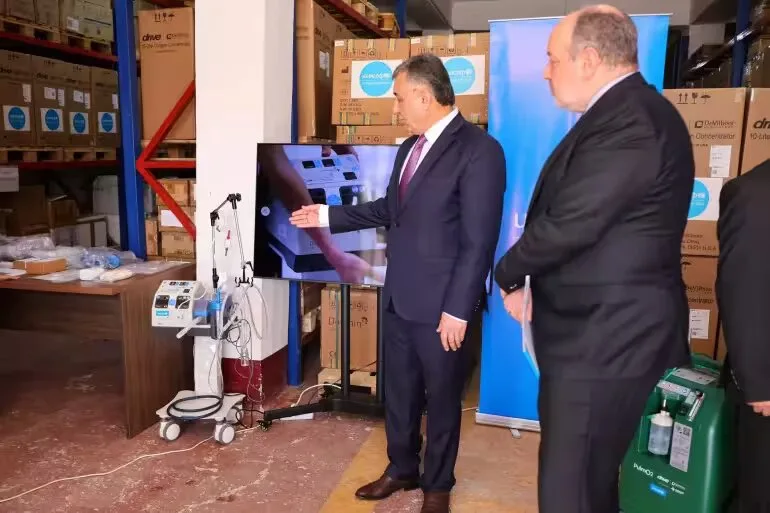
International NGOs deliver diagnostic equipment to Afghan provinces
By Modern Medical Solutions Editorial Team

A coalition of humanitarian organisations delivered ultrasound units, ECG machines and point-of-care diagnostic devices to provincial hospitals in Herat, Mazar-i-Sharif and Kandahar, extending diagnostic capability beyond the capital.
Extending Diagnostic Reach Beyond the Capital
Diagnostic capability has long clustered in national capitals, and moving ultrasound, ECG and point-of-care testing into provincial hospitals addresses a persistent gap in access. When a district facility can perform a scan or record a cardiac trace on site, patients avoid long and sometimes dangerous journeys for basic assessment, and clinicians can triage and refer with far greater precision than guesswork or clinical impression alone would allow.
Provincial equipping also strengthens the wider referral network rather than a single site. A hospital that can identify which patients genuinely need transfer to a tertiary centre uses scarce transport and specialist capacity more wisely, and the whole system benefits when referrals arrive better characterised. In effect, distributing diagnostics outward makes every downstream service more efficient at concentrating its effort where it counts.
There is a demographic dimension worth noting as well. Populations distant from the capital have historically borne the sharpest inequities in access, and placing diagnostic tools in provincial hospitals narrows that gap directly and visibly. It shifts the point at which a patient's condition can first be objectively assessed closer to where they actually live, which for many conditions is the single most important determinant of whether a treatable problem is caught in time to make a difference to the outcome.
What Point-of-Care Diagnostics Change on the Ward
Point-of-care devices compress the diagnostic loop dramatically. Instead of sending samples to a distant laboratory and waiting, staff obtain results at the bedside, which is transformative in emergency and maternal care where timing shapes outcomes. Portable ultrasound and ECG extend this immediacy to imaging and cardiac assessment, tools that were once confined to referral hospitals and effectively unavailable to most provincial patients until they had already travelled far from home to reach them.
For cardiac patients the ECG is a first gatekeeper. A recorded trace can distinguish those who need urgent transfer from those who can be managed locally, and in the context of chest pain that distinction is the entry point to the interventional pathway. Reliable frontline diagnostics are what allow later, more specialised care to be targeted where it will genuinely help, rather than diffused across undifferentiated presentations that overwhelm scarce specialist capacity and delay the patients who most urgently need it.
Why Basic Diagnostics Feed the Interventional Pathway
There is a direct line from a provincial ECG to a catheterisation laboratory. Recognising ischaemic changes early lets clinicians activate referral before myocardial damage becomes irreversible, and a well-functioning diagnostic base is what makes downstream investment in interventional services worthwhile. Advanced coronary work only delivers value when patients reach it in time and correctly identified, which the diagnostic frontline makes possible.
This is why equipping the periphery matters even to specialist centres. A cardiac programme cannot treat patients it never sees, so the diagnostic frontline effectively defines the catchment for interventional cardiology. Strengthening provincial diagnostics therefore quietly expands the reach of every downstream service, including the guidewire and catheter-based procedures listed across the broader interventional product catalogue that referral centres depend upon.
Sustaining Donated Equipment Over Time
Donation is the easy part; keeping equipment working is the enduring challenge. Ultrasound and ECG units need calibration, consumables, spare parts and trained operators, and without a maintenance plan donated devices can fall idle within a year or two. Sustainable programmes pair delivery with training, service arrangements and a stable supply of accessories, treating the handover as the start of a relationship rather than its conclusion.
Continuity of supply is what preserves the value of any equipment investment across its working life. Provincial facilities planning further capability can discuss their consumable needs through the contact and quote channels that keep diagnostic and interventional services running once the initial donations have been installed and commissioned.
How Coalitions Coordinate Provincial Delivery
A coalition of humanitarian organisations brings both reach and complexity to a delivery of this kind. Pooling resources lets partners cover more provinces than any single body could manage alone, but it also demands careful coordination so that equipment is matched to each hospital's real needs rather than distributed uniformly regardless of local capability. The strength of a coalition lies in that division of labour when it is well organised.
Coordination extends to the practicalities of installation, staff orientation and follow-up. A well-run programme confirms that receiving hospitals have the power supply, space and trained personnel to use what arrives, because even the most appropriate device is inert without the conditions to operate it. This attention to fit is what separates a considered delivery from a symbolic one, and it is often the least visible part of the work that determines whether the equipment is genuinely used.
Seen analytically, the coalition model mirrors the referral system it supports: distributed effort, coordinated toward a common outcome. When partners align their contributions to the actual clinical geography of a province, the collective result is far greater than the sum of individually well-intentioned donations arriving without a shared plan.
A Foundation for Broader Capability
Provincial diagnostics form the base of a pyramid that rises toward specialist care. Once a hospital can reliably scan, test and record, it becomes a credible node in a referral chain and a candidate for staged capability growth. The devices delivered here are modest individually but collectively reshape where and how quickly patients are assessed, which is often the decisive factor in whether treatment arrives in time.
The lasting measure of such a programme will be whether these tools remain in daily use, feeding accurate referrals upward and giving specialist centres a steadier stream of correctly identified patients. That quiet integration into routine practice is what turns a one-off delivery into durable system strengthening, and it is a far better indicator of success than the number of boxes unloaded on inauguration day. A device used a hundred times a month has justified itself many times over; one gathering dust has not, however impressive it looked on arrival.
Frequently asked questions
How do provincial diagnostics connect to interventional cardiology services?
Frontline tools like ECG identify patients with cardiac events early and support timely referral to a catheterisation centre. Because interventional cardiology only benefits patients who reach it correctly identified and in time, a strong diagnostic base effectively defines the catchment for advanced procedures. Investing in the periphery therefore extends the practical reach of specialist coronary services well beyond the referral hospital itself.
What is needed to keep donated diagnostic equipment operational?
Donated devices require calibration, spare parts, consumables and trained operators to stay useful. Without a maintenance and resupply plan, units can fall idle quickly. Facilities should pair equipment with service arrangements and a dependable source of accessories; discussing requirements early with a supplier helps map which consumables and support items each device will need across its working life rather than discovering gaps later.
Why prioritise point-of-care testing in provincial hospitals?
Point-of-care testing returns results at the bedside rather than after a delay for distant laboratory processing. In emergency and maternal care that speed can change outcomes, and it lets provincial staff triage and refer with confidence. Combined with portable ultrasound and ECG, it brings a meaningful diagnostic layer to facilities that previously had to send patients elsewhere for even basic assessment.