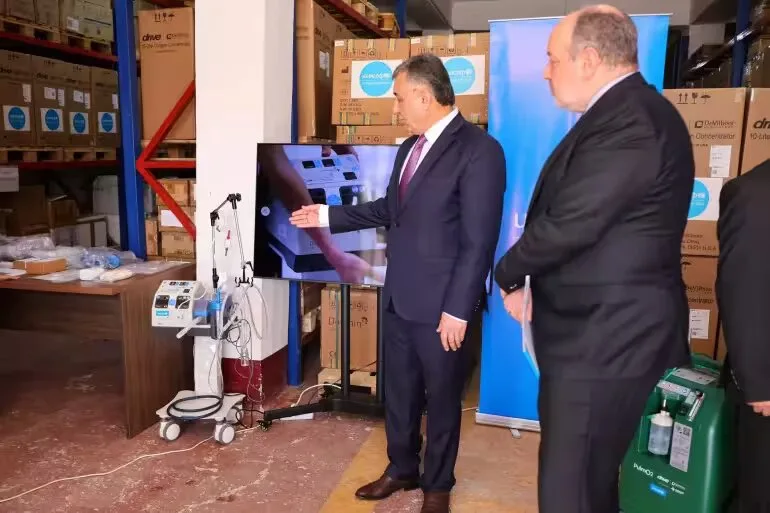
WHO delivers surgical and interventional equipment to Kabul hospitals
By Modern Medical Solutions Editorial Team

The World Health Organization supplied a new batch of surgical instruments, catheterisation lab consumables and monitoring devices to three major Kabul referral hospitals, supporting the expansion of elective and emergency interventional procedures in Afghanistan.
Supplying surgical instruments, catheterisation lab consumables and monitoring devices to three referral hospitals is the kind of practical support that underpins expanded procedural care. Referral hospitals sit at the top of a health system, handling the complex cases that smaller facilities cannot manage, and their capacity depends heavily on a steady flow of the right consumables and functioning equipment across many procedures each day. When any part of that flow falters, the effects concentrate precisely where the wider system can least afford to lose capacity.
The mention of catheterisation lab consumables is particularly significant, because cath labs are among the most consumable-intensive environments in any hospital. Each interventional procedure draws on a range of single-use items, and the ability to expand both elective and emergency work rests directly on keeping those items reliably in stock at all times. A batch delivery is a welcome and immediate boost, but the harder question is always what happens once it is used up and the resupply has to sustain itself without a fresh donation to lean on.
Cath Labs Run on Consumables
Analysed through a supply-chain lens, a catheterisation laboratory is defined less by its fixed imaging equipment than by the constant stream of single-use items that pass through it every working day. Interventional procedures depend on coronary guidewires, microcatheters, balloons and monitoring supplies, each consumed per case and each requiring a dependable resupply pipeline to avoid cancelled procedures. The imaging system may serve reliably for a decade; the consumables it enables are used up and replaced continuously, case after case.
This consumable intensity means cath lab expansion succeeds or fails on logistics as surely as on clinical skill. A lab can have excellent imaging and highly skilled operators yet grind to a complete halt if a single category of consumable runs out, because the missing item usually cannot be improvised or substituted safely mid-procedure. Sustaining expanded interventional capacity therefore means building supply lines robust enough to keep pace with rising case volumes, forecasting demand across the full range of items rather than reacting only once a shelf is discovered empty on the morning of a busy list.
Monitoring Devices and Their Upkeep
Monitoring devices are essential to safe surgical and interventional work, tracking the vital signs that alert teams to trouble in real time and giving operators the information they need to act before a problem becomes a crisis. But monitors, like all electronics, require maintenance, calibration and their own consumables such as sensors, leads and cables that wear out with use. A monitor giving inaccurate readings is arguably more dangerous than none at all, which is exactly why servicing is not optional for this class of equipment in any serious procedural setting.
Sustaining a fleet of monitoring devices means planning for calibration schedules, replacement sensors and technical support from the very outset rather than as an afterthought. When those provisions are in place, the equipment supports safer procedures for years and quietly earns back its cost many times over in avoided complications. When they are neglected, the newest monitors can become unreliable surprisingly quickly, undermining the very safety they were installed to provide and slowly eroding the confidence that any expansion of procedural work fundamentally depends upon.
Surgical instruments sit at the more durable end of this spectrum, but they are not exempt from the same logic. They require cleaning, sterilisation and eventual replacement as edges dull and mechanisms wear, and a set that cannot be reliably reprocessed between cases becomes a bottleneck rather than an asset. Even the most robust hardware, in other words, still depends on the consumables and processes that surround it to translate its presence into completed procedures on the operating list.
Expanding Interventional Work Sustainably
Expanding both elective and emergency interventional procedures raises the demand for consumables in a way that must be carefully forecast, not merely hoped for. Emergency work is inherently unpredictable in its timing and its clinical demands, so facilities need adequate buffer stock and reliable resupply to avoid being caught short when a difficult case arrives without warning in the middle of the night. Building that resilience into the supply system is what allows expansion to be genuinely safe and sustained rather than sporadic and fragile.
Dependable access to coronary microcatheters and guide catheters and other interventional consumables, backed by import support that anticipates cross-border logistics, is central to keeping expanded services running through the inevitable disruptions that any supply chain will eventually face. Without that depth and reliability, capacity gains risk stalling the very first time a shipment is delayed, leaving a well-equipped lab unable to work for want of a single category of item that should never have been allowed to run out unnoticed.
What the WHO Typically Supports
The World Health Organization commonly supports health systems under strain by supplying essential equipment and consumables, setting technical standards and reinforcing the capacity of referral facilities that so many others quietly depend upon. Its involvement usually reflects an emphasis on sustaining critical services where local supply chains face disruption, and on strengthening the institutions at the top of the system whose failure would cascade downwards to every smaller facility that refers its most complex patients up to them.
For hospitals expanding interventional care, that kind of support addresses an immediate and pressing need while pointing to a longer and harder challenge. The task is to turn a one-time delivery into a sustained supply of the consumables and servicing that keep advanced procedures available to patients month after month, so that the batch arriving today becomes the beginning of a dependable capability rather than a brief spike of activity followed by a familiar return to shortage once the last of the boxes has finally been emptied.
Frequently asked questions
Why are catheterisation labs so dependent on consumables?
Every interventional procedure in a cath lab consumes a range of single-use items such as guidewires, microcatheters, balloons and monitoring supplies. Unlike fixed imaging equipment, these are used up case by case. A lab can have excellent imaging and skilled operators yet cancel procedures if any one consumable category runs out, so reliable resupply is essential to expanding interventional work safely.
Why do monitoring devices need ongoing maintenance?
Monitoring devices track vital signs that alert teams to danger during procedures, so accuracy is critical. Like all electronics they require calibration, servicing and their own consumables such as sensors and cables. A monitor giving inaccurate readings is more hazardous than none at all, which is why planning for maintenance and replacement parts is essential rather than optional for this equipment.